
EKS Lesson Eight Introducing minor scales
EKS Lesson Eight Introducing minor scales
As stated in the introduction, there is a relationship between the minor triad and the minor scale which is best explained to you in steps:
You will recall that there are seven notes in a scale with the root note (A in this case) repeated at the top of the scale to give us an octave.
Therefore, our A minor scale is:
A, B, C, D, E, F, G, A
Look at our example and then practise playing the scale up and down using the thumb under and finger over techniques we learned earlier in the course.
Figure 1. A minor scale (Enlarge)
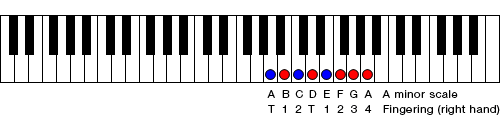
As always, there are supportive multimedia files and we have written the music out below. Try and learn the scale by remembering the notes in the scale.



|
