EGS Lesson Six Developing our understanding of the fingerboard — 6th and 5th string geography
EGS Lesson Six Developing our understanding of the fingerboard — 6th and 5th string geography
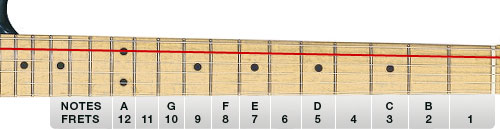
In the diagrams that follow, we can see a picture of the fingerboard with all the natural notes on the sixth and fifth strings being marked.
A note which is not a sharp ( # ), or a flat ( b ), is called a ‘natural’.
Look at the diagrams, you will notice that there is a jump of two frets between each of the notes marked in the diagrams.
Starting on the sixth string at the first fret with F; there is a two fret jump to G, then a two fret jump to A, and so on.
There are, however, two exceptions to this rule:
These notes must be learned thoroughly.
Figure 1. Natural notes on the 6th string (E string) up to the 12th fret
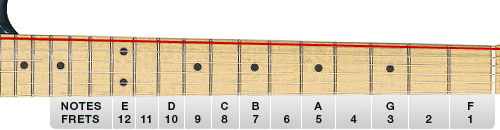
Figure 2. Natural notes on the 5th string (A string) up to the 12th fret