
EGS Lesson Six Developing our understanding of the fingerboard — 6th and 5th string geography
EGS Lesson Six Developing our understanding of the fingerboard — 6th and 5th string geography
To complete the notes on the fifth and sixth strings we need to learn ‘sharp’ and ‘flat’ notes.
Sharp means ‘higher’ and is denoted with the following symbol: ‘#’
Flat means ‘lower’ and is denoted with the following symbol: ‘b’
Consequently, seeing a chord named ‘F#5’ means a power chord of ‘F sharp’. ‘Bb5’ would mean a power chord of ‘Bb’.
In the diagrams, all notes are marked up to and including the twelfth fret on the fifth and sixth strings.
All of the natural notes should have been thoroughly memorized before moving on to the sharps and flats.
Figure 3. Sharp and flat notes on the 6th string (E string) up to the 12th fret

Figure 4. Sharp and flat notes on the 5th string (A string) up to the 12th fret
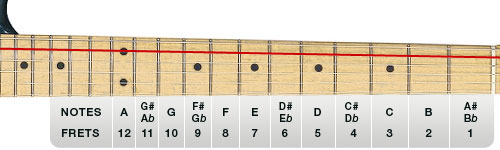
If the naturals have been memorized, you will find that memorizing the sharps and flats are relatively easy as, for instance, Bb will be one fret lower than B.
G# will be one fret higher than G and so on.
Notice how the frets containing sharps and flats have two note names per fret.
F# is the same note as Gb.
C# is the same note as Db.
A# is the same note as Bb, and so on.
In a piece of music, the note which falls on the second fret of the sixth string is called either F# or Gb — depending on which key the piece of music is in. Key signatures require detailed explanation, so we will discuss this later as we do not need to know the full picture at this point. All you need to know is that the chords of F# and Gb are played in exactly the same way.
We now have twelve different power chords, each of which is playable in two positions on the neck. This leads to a huge number of possible combinations of chords.
You should definitely explore the neck, learning how to move between these new chords. But to get you started, we have laid out a few suggestions for you in the next section.
