
EKS Lesson Nine Developing minor triads
EKS Lesson Nine Developing minor triads
So far you have learned to play minor triads in root position. This means that the root note of the chord is in position at the base, or bottom, of the chord. This can result in a lot of work for the left hand when playing different chords in a chord progression.
You will recall that we looked at minimizing movement by using inversions in the first half of this part of the course, when we looked at major triads. We are going to do the same again for our newly learned minor triads.
I would like to illustrate, again, how inversions work using A minor and D minor.
We know that the notes in an A minor triad are:
A, C and E.
The notes in a D minor triad are:
D, F and A.
The concept with inversions is recognizing which are the common notes in different triads, and then use those notes so as to change as few notes as possible when changing chords. Therefore, if we take A minor and D minor, we can see that the common note is A.
In Figure 4, we can see where your fingers would have to be to play both the chords in root position.
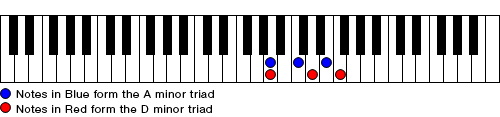
Figure 5 shows that, by retaining the common note of A with our thumb, we simply have to move finger two up from C to D, and finger four up from E to F.
This creates an inversion of D minor with A at the base of the chord.
Figure 4. Changing from A minor to D minor in root positions (Enlarge)
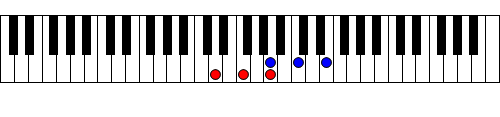
Figure 5. Changing from A minor to D minor creating an inversion of D minor (Enlarge)
Next: Economy of movement
