
EGS Lesson Three Introducing eighth notes and developing rhythm guitar playing
EGS Lesson Three Introducing eighth notes and developing rhythm guitar playing
You will recall that a whole note lasts for four (4) beats. A half note lasts for two (2) beats and a quarter note for one (1) beat. Accordingly, an eighth note lasts for half (½) of a beat as it divides a bar of common time into eight.
Below is an example of an eighth note. You will notice that it is a filled in note and has not only a stem, but also has a tail. The tail distinguishes it from a quarter note.
Eighth notes are often joined together with beams and grouped into two eighth notes, making up one beat. It makes them much easier to read quickly.
Below is a bar of quarter notes followed by a bar of eighth notes. You will see that eighth notes are counted: “1 and 2 and 3 and 4 and”. We use the ‘+’ sign to denote ‘and’.
Use the media files as always to play the rhythm of these two bars round and round. This will help you get used to playing eighth notes and understand how they relate to quarter notes. Use the chord of A5 for both bars.

Worth half a beat.
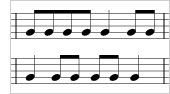
Besides being grouped into twos, eighth notes are also commonly grouped in fours. Each group is then worth two beats, or half a bar of common time. When mixed with other note values, as in the example above, the groupings are arranged to make it easy to see where the middle of the bar is. Being able to identify the middle of the bar makes it easier for musicians to read the music fluently as they play.



|
